
The information on this page was last updated on 03-13-2026 and was provided by the Luminary.
Ismail Alabdullah
Credentials
Humanitarian Cause
Emergency Response, Rescue in emergency situations, Supporting communities in climate-vulnerable regions
Impact Location
Syria
Occupation
Humanitarian worker / Member, White Helmets (Syria Civil Defence)
Photo Gallery
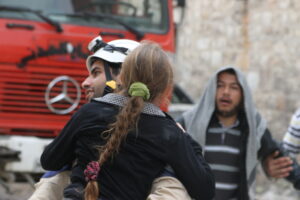
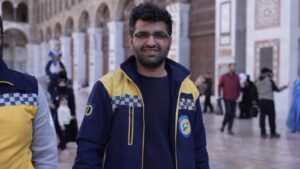
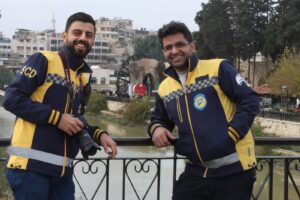
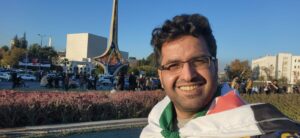
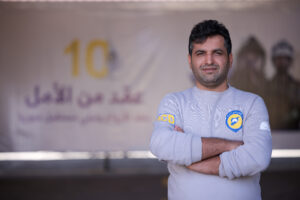
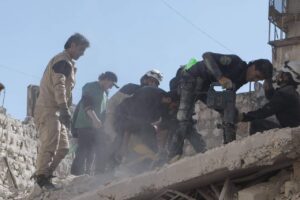
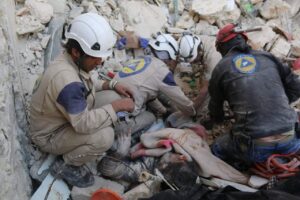
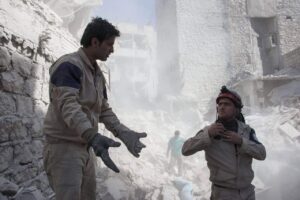
Ismail Alabdullah is a Syrian humanitarian and longtime member of the White Helmets (currently known as Syria Civil Defence) who has dedicated more than a decade to rescuing civilians from bombed buildings and disaster sites, contributing to the group’s record of saving more than 128,000 lives. A former English teacher from rural Aleppo, Ismail is widely cited in regional and international media for his credible, on-the-ground testimony about civilian harm and humanitarian needs.
In March 2011, Ismail joined the protests that erupted across Syria as part of the Arab Spring. What began as a peaceful popular movement involving millions of civilians demanding freedom and reform was met with violent repression and eventually escalated into the devastating Syrian Civil War. As a result of the war, Ismail lost his home and, like millions of others, was forced into displacement. He and his family ended up living on the outskirts of Aleppo.
“We are living day by day, hour by hour, without ambition, without looking to the future, without planning to complete our lives normally because the fear of bombing changes everything,” he noted.
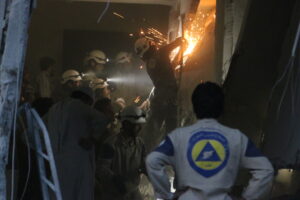
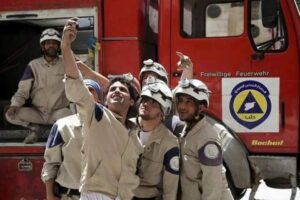
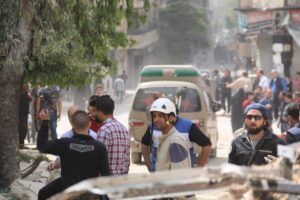
After initially distributing aid with the Red Cross, Ismail later joined the White Helmets in 2013, serving both on the frontlines as a first responder and as a media coordinator and spokesperson. In this dual role, he documented airstrikes, sieges, and attacks on civilian infrastructure while advocating internationally for protection, accountability, and humanitarian access. Working under extreme risk, Ismail repeatedly entered unstable buildings despite the dangers of secondary strikes and structural collapse. Despite opportunities to relocate abroad, he chose to remain in Syria, continuing to serve communities in Aleppo and Idlib. He follows the White Helmets’ motto, drawn from the Quran: “To save one life is to save all of humanity.”
When an earthquake struck northern Syria on February 6, 2023, the team was among the first to respond. Over 580 buildings collapsed completely, more than 1,500 were partially damaged, and more than 40,000 people were left homeless.
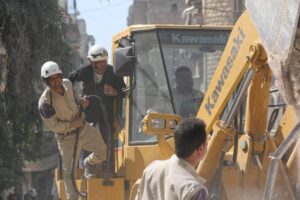
“We did what we could with our bare hands, limited vehicles, and equipment,” Ismail recalled. “Carried forward by the generosity of our local communities and supporters around the world, we saved 2,950 lives and recovered the bodies of 2,172 victims so that their families could give them dignified burials.”
Following Syria’s December 2024 political transition, the White Helmets were integrated into the newly formed Ministry of Disaster and Emergency Response Management, now known as Syria Civil Defence. Since early 2025, Ismail has been reassessing his role as this institutional shift continues.
Under the new structure, volunteers are being trained as firefighters, paramedics, and deminers. Teams are working at mass-grave sites to document the dead and help build the forensic capacity Syria urgently needs. As Ismail points out, “More than half a million people are missing, and their families are still waiting to know their fate.”
Through his work, Ismail Alabdullah has saved lives both directly through rescues and indirectly by mobilizing global attention and support for communities in crisis.